Showing posts with label Year 4. Show all posts

Wednesday, 2 April 2014

Hola

It's been a few weeks. 
I've discovered Instagram. Say no more. 
Pinterest and Instagram...there's no hope for me. 
I have however, given up Facebook so that's my excuse. That's the extent of the socialising in the P 'n P house.

My gratuitous Instagram for the day (the April challenge, 'in my hand'):


And there have been no pedicures or indulgence to kinda back up the blog's name. I'm not doing the expat wife reputation any good!

It's all been about ticking off checklists especially for my sister's hen do planning. But that is all now booked. Watch this space for some fun and japes in the summer. 

So...school then.

The last couple of weeks in year 4 have been all about the art of India. We have looked specifically at Rangoli but also at henna/mendhi. Even the boys had a go at designing once they had shaken their heads into their hands.

Rangoli is such a skill! We looked at pictures and videos and were amazed how they could scatter the sand/rice flour so neatly and precisely. The ladies made it look so easy. 

Everyone created a chalk rangoli, planning and working from the grid of dots all the way to the symmetrical colour design. One group of four in each class were to design a rangoli together and then make it out of sand outside the classroom. This was a great activity and one I will only tweak a little but definitely do again next year.


The sand rangoli group worked really well especially after the early frustration of making the grid of dots much bigger than what was in their sketchbook but also because of the fact it was really hard to sprinkle the sand! Even I had a go and I made it look like I was salting my dinner!


Monday, 17 February 2014

James Rizzi 2014 style

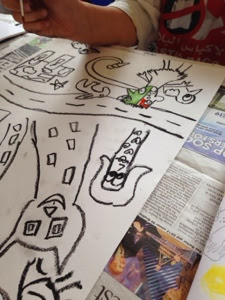
Well, the bowls didn't work out, remember? So look at the work in progress.
One girl just couldn't stop giggling at her work! Love it!


Thursday, 13 February 2014

To the Parents

I had a revelation last week. It might not seem a great one to many but personally it has added to my development as a teacher, my awareness of the child's learning as a whole and not just in the class...the Whole Child - what I was fundamentally interested in back in my PGCE days. 

It has occurred to me that that these inspired, imaginative, wonderfully wacky, mostly so un-selfconscious little artists that are in my classroom might not feel so inspired and imaginative and wacky and un-selfconscious when they leave the 'art room'. I have just assumed they carry this with them to the home and if the inspiration grabs them, they'll get their crayons and paints and glue and deal with what's in their mind. 

However.

We attempted to make papier mâché bowls last week in year 4. It worked last year, somehow we all struggled a bit this year. Not a problem. We made it an evaluation lesson. This was invaluable actually and I'm glad it happened. Especially for our little perfectionists (including yours truly).
 
I did make (a mistake in hindsight I wonder) the decision to let the kids take their newspaper bowl home and try and do something with it, resurrect it, build on it, start again....basically see this through. The parents' reactions didn't even occur to me. Until one texted me a photo of the thin newspaper rough bowl-shape his daughter had made, 'jokingly' saying that the new art room [with the new school build] couldn't come soon enough.

And that's when it hit me. Any inspiration or motivation for some children stops at the school gates when the parents ask what on earth is that and the child's self-consciousness flames up and they are unable to express what they want to do with their art, their creation. In class most of them were excited about doing something with it at home and I bet none of them have. I'd sent most of these kids home with some scrappy papier mâché with the incentive that they could fix it and be inspired to do something. I forgot someone could be in the car or at the door going wtf is THAT? And this poor child trying to explain. She's just going to put it in the bin. Which child is strong enough to tell them to keep hold of it, they have plans for it.  Maybe one, possible two in that class. And so begins the downward spiral of forever squished creativity and unconsidered self esteem levels.

No wonder adults don't get out their crayons anymore. I have actually seen it in process now. And once it leaves my art room, what can I do? I have no other help to continually boost these kids' creativity and imaginative processes once they put down my paintbrushes. Maybe the grown-ups have little confidence. As Picasso said:

Please, parents, art is just as important to your child's development, not only academic but spiritual and creatively. She may not need it in the career you're seeing her in but she will need mental release and self expression and the space and confidence in which to do this. So what if she brings home a crunchy indescript piece of paper, to you that's what it is. To her she sees colours and shapes and connections, it's art, ideas and thoughts...it's HERS. Bite your tongue. Watch her do something with it, watch her plan, watch her work, watch her think, inspire her yourself if she's stuck, let her reach an outcome of her own, take a photograph before and of the finished article and then you can be done with it, content in the knowledge you have let your child see a plan through to the end. The journey is just as important as the destination. Give them the time and space and above all belief and encouragement to show you what their vision is. Maybe this is all you need to get your crayons back out after all this time...
Pablo and Paloma Picasso: Why not get arty WITH your child?
It's not what they've brought home, that is the final product. Art should never end in my class, let them continue it in their home space. Let them get messy. Let them invent and create. These are the industrial designers, inventors and thinkers of our future society, remember...they need their brains expanded!

I know he's not an artist. Or in primary school. But as a parent I always try and think like Michio Kaku's Mum:


Wednesday, 8 January 2014

First week back...

...two days in and I'm toasted!!! My Christmas holidays must have been relaxing!

I've come across some new and super lesson ideas this week, most likely to be tweaked for me and my ways. The art teacher community has helped me build a much more varied and fluid curriculum for the school and I am lucky that I have the freedom to do so. I'm already liking to keep things fresh and new every year, for the kids' benefits as well as mine. And to vary the corridors from term to term, year to year.
 
Today I had my lovely Year 4s, both classes. As it is an incomplete week being the first week back and all, I don't start big projects as kids are still on holidays. Go figure. That'd be nice. Anyway, it's too much hassle and catch-up. 

So I had a cool and fun activity from Goddess Patti at Deep Space Sparkle, one of her 45 minute ones. 
http://www.deepspacesparkle.com/2011/04/04/robot-line-drawing/
 
Doing this today and following my evaluation I've been inspired to build a block of focused lessons across the key stage on line. Some of year 4's line creation and control was rather dubious and concerning so I thought, across the board, line work should be practised at the start of term, or any time I guess, to get their eye and hand back in after the holidays. A possible block for after Easter so nobody misses out.

Year 4 also learn a little about Wasily Kandinsky and his passion for music and painting. We have fun with music seeing how it motivates us to create shape and line at the end of the summer term but this could be spring, again to keep their hand in.
Originally from http://www.artsonia.com/museum/gallery.asp?exhibit=698199
Year 3 can have a go at line drawing Vincent van Gogh's Starry Night. We do a lesson on mark marking that ties in with Van Gogh so this would work together.
Originally from http://www.artsonia.com/museum/gallery.asp?exhibit=741877
 I could even make use of this Pin: 


X

Saturday, 13 April 2013

Art Lesson of the Week 1

It’s our first week back after the Easter break, a short week, but no less fun! And no better time to start (better late than never) to highlight my fave lessons.

I thought I had already decided on which lesson would be made my favourite before the week was done…but I’ve now learned to not think it’s not over until it’s over. So I’m actually going to highlight two lessons from this week that I saw the kids loved and I also loved too, both for different reasons.

a) Year 4 - Grecian Vases

We looked at the different vases that the Greeks used and talked about the different uses as well as the designs. Some designs highlighted what the purpose of the vase was, some were just decorative and often represented everyday life. We talked about the patterns that were typical of the style. We went to our sketchbooks and planned our own design for our vases. The first year 4 class had the issue of technology fail so I couldn’t show them the pictures in order to compare designs so we went by books, albeit a rather limited number in the class but enough to inspire. This year 4 class tended to focus on pattern and missed the point that many vases depicted scenes from daily life.

I had several templates of three particular vase designs. The children drew around the vase and then filled in the shape with oil pastels. We talked about the difference between oil and chalk pastels and so those who picked up a chalk pastel and worked with it by mistake could tell which it was. They filled in the shape with heavy pastel so that the paint would slip on to it.

I’ve chosen this lesson as a favourite because of the way it evolved during the hour. My original plan was to allow the paint to dry and next week scrape away at it to reveal the colour beneath. But as I demonstrated it it suddenly occurred to me to scrape the paint whilst wet. And it worked brilliantly, as long as the colour underneath was thick and bright, the paint would scrape off it and not lose any of the oil pastel. It was a lot more vibrant. I demonstrated what would happen if it was dry and we all agreed it was a lot better. We ended up as a result finishing the activity in one lesson.

It’s worth making sure that the children lay the crayon/pastel on thick…I showed what would happen if we just shaded gently…the crayon would have been scraped off with the paint and would just leave the paper showing. I just used black ready mixed tempera paint.


This lesson was one that reminded me again why I really like teaching art, it doesn’t have to be prescriptive..as long as the curriculum is followed with the success criteria being met in an evolving lesson then great! I think this is a good lesson for the kids in itself so the children can see how thoughts and plans in art can be developed.

2) Year 6 - Pablo Picasso’s Guernica

This simply was a gobsmacking lesson.

I revelled in the developing thoughts and ideas coming from the 10/11 year olds as we went through the lesson. We started off with a good old PowerPoint on Picasso. I shared my personal opinion of the man; that I think he was a lovely, charming, funny, deepy thoughtful man yet his art does not appeal to me. I went to his exhibition at the Scottish National Gallery of Modern Art in Edinburgh last summer. A great insight in to his life as well as his main works.

The aim today really was to introduce them to the skill of art critiquing, for them to express and justify their thoughts, feelings, likes and dislikes and ultimately aim to offer interpretations (expected to be basic at this stage). I then showed them Guernica – with no background information - and left them with it for 5 minutes to discuss.
Random, chaotic, dull, boring, weird, creepy were the standard and expected responses. A few of the girls were on the right track, suggesting the symbols that may represent war or death.

I then proceeded to tell them the background of Guernica. They had already been studying World War 2 so the vocabulary of battle, Fascists, Communists, And then the floodgates opened! This had obviously sparked the interest of one boy (E) who always had a suggestion or a question at every stage.

I wanted them to share ideas in groups about the painting, creating spidergrams. They were to think about the following questions: why did Picasso paint this in black and white? What was Picasso’s point in painting this? Why abstracted? How does Picasso portray the innocence of the suffering people? (this one was a corker – some great ideas!)

I finished off by showing them Picasso’s weeping woman and we discussed why he could have painted this. This raised some conversation as to why he painted in colour, namely green and blue yet he was painting his interpretation of a sombre event, a mother crying over her son’s dead body. I left them with that query, why colour in this one yet black and white in Guernica. It was interesting trying to get the point across that Picasso was expressing his mood about the battle and the death of innocent people.


I'm really looking forward to the lesson this week and hearing E's research. He has done some full-on homework on it by all accounts!