Showing posts with label Art Lesson of the Week. Show all posts

Tuesday, 28 January 2014

JOINT Lesson of the week

Aboriginal Bark Paintings
 
This is a lesson/activity based on the one in the book, Art from Different Cultures. And Year 3 have made it our own every year.
 
So crumpled up rough beige sugar paper became the bark. They sketched their chosen animal one and added some colour with some chalks. This made a nice contrast to the bright earthy paints they'd use next.
 
Then the aboriginal dot style began! It was all too easy for them to hap-hazardly dab the cotton buds randomly so I had to guide them back to the original Aborigine paintings and get them to think why they're different; what technique is different? How?
 
Of course my little 7-8 year olds won't be the aboriginal artists with 30 years plus of practice but we all know and remind ourselves, even me, that we can start practicing at any time!


Some children wanted to use the aboriginal dreamtime story symbols to tell a picture story around and about their animal.


Fingertips! The best!

Friday, 3 January 2014

Plans afoot...


Another year has passed, nay, flown by. My analogy for the year as far as my blog is concerned is you know when you start to trail off towards the end of a sentence...? Well, that's it. More especially because you keep spotting something shiny whilst you're speaking. That's my blog. I keep wishing I could write like the girls who write the art lesson blogs I follow. But hey. Life has got in the way of regular blogging. But you know what, I really am happy with that. So be it.

This year's plans (remembering a plan is a basis for change ;-)):

:: keep going with Artist of the Month but with focus on the artist I choose for the spotlight board on the KS2 board at school. Lesser well known ones for the kids to comment on.

:: artwork of the moment, again that comes from the KS2 art board.

:: more focus on the children's art work here


:: my sister's wedding. For me beforehand, this encompasses hen do plans and bridesmaids' dresses. Sooooooo excited....

:: my solo trip over the summer :-) for another tick off the bucket list.

:: and continuing to tick, more like enjoy, a few more things from the bucket list

:: this is my 40th year. I will be setting on a 40th Birthday project that I will complete by the time I turn 40 in January 2015. So watch this space for updates through the year :-)

:: each morning, be thankful for another day. And the people who feature in it. And for what they are teaching me, whether they realise it or not!

My 2013 conclusions:
Be peaceful and happy.
Be thankful.
Look for the lessons in the day.
Do not force or push my way through life. Peace will set in when I slow down.
To have real friends I must be a real friend.
I am not afraid to ask for help.
The washing up can wait. Go tickle my children. Or have a Brandy Alexander :-)
Listen to my body.

Happy New Year.
X

Monday, 30 September 2013

Lesson of the Week...Weather in Art

I love this one. Weather. Art. Together. Awesome. 
The tangents you (well, ok, I) can take this off are deep and endless but with my little year 3s it's just a small step for now. I'd like to eventually set up plans for weather in art up to year 6 and bring in 'meteoropathy. This fascinates me, ever since I saw Ola Rek exhibiting at the National Gallery in Glasgow a couple of years ago. She's October's artist of the month.


Wednesday, 12 June 2013

Lesson of the Week Part 2

This week we started to paint the sculptures. I gave the children the freedom. They could pick a theme and showed them plenty of pictures and examples for inspiration. I made one alongside them so I'll give it a go too. I think I'm going for some lovely blues and my favourites henna inspired swirly design somewhere. Anyway, more importantly, here are some of the kids'. work... 


I'd love to have the free mind of a child again, no restrictions, no hindrances...these are just brilliant. Their own styles coming into play in year 6 ready for big school.
As Picasso said....
 

I shall miss this year 6 greatly.

Thursday, 6 June 2013

Lesson of the week Part 1

I have been hanging on to do this with year 6 ALL term...I was so excited and kept promising them we'd end the term with something so cool. I made sure I kept it secret. Then I'd let little things out, possibly because I couldn't contain my excitement! I only said we were doing sculpture. This conjures up wonderful images of clay and bronze and chisels and hammers...but this was a little different...certainly a lot more accessible!
This was the wire hanger and 'pantyhose' (because I'm British I'm going to call it popsock from hereon in if you don't mind!) sculpture I'd seen on Pinterest (I <3 you) and a Google check for more instructions.

It took a LOT of prep but prep I could cope with compared to papier mache prep...ugh...

Resources:
  • Enough wire coat hangers. Ask your friendly ICT teacher for his spare dry cleaning hangers
  • Wooden blocks cut from some old 3x5 timber we had (it was actually from our camp fire stockpile but mum's the word...). Another option next year would be to stick the wire hanger ends into a lump of clay and mould that as a base and maybe incorporate that into the sculpture
  • Cheapy popsocks. Don't go and get a pair for each child, get to the cash desk before you realise you only need one sock per child's sculpture and therefore half the number of boxes you picked up and have to put 13 pairs of pop socks back on the shelf (Advice: do this early in the morning to avoid too many funny looks)
  • Base covering. Some sites suggest just white paint (likely to crack when dry especially when painted over), other's suggested spray paint (wouldn't want the smell even outside and lingering inside especially in a bulk amount of sculptures), I went for the gesso option but it is a fortune in the local art shop, for a class-worth anyway. So I made my own. I'll be posting on that next. Really glad I made it!
This is what I did. Any amendment or suggestion to better the method please throw it my way please!

Step 1 - The Frame (needs to be done days in advance for the glue to dry)
  • Drill the holes in the block
  • Untwist the hangers. Grab your long-suffering partner to help. Taking off the hook is an option or you could straighten it out. As long as the ends are straight to go into the drilled holes
  • Fill the holes with wood glue or contact cement (that suits all materials)
  • Stick in the hanger ends as far as possible and leave to dry


Step 2 - The Gesso. I made this the night before.

Step 3 - Unpack the Popsocks to save time!

Step 4 - Surprise the kids - Day of the Project. ExciiiiiiitIIIING! Even more so because this was an extra art session I had arranged with Mrs. C and we agreed to make it a surprise. I know, who said art should be fun...

Step 5 - Mould the wire frame. Encourage small, gentle movements, maybe in opposing forces and directions. Think about forward and backward movement rather than a flat plane.


Step 6 - Pop sock time. Stretch the sock over pulling down  from what would be the toe so there are no baggy, saggy bits. I got them to put the band around the block of wood so there was still a flat stable surface underneath.


Step 7 - A few tweaks to bend the frame a bit more where they needed it. They realised here that the sock will not always follow the line of the wire and may stretch from one point to another.

Step 8 - Time to coat. The room was filled with the gorgeous smell of baby powder! What a beautiful, emulsive , gloopy mixture. They worked on covering their sculpture, layering it up rather than one thick layer, keeping the layers even, covering the texture of the sock.

Step 9 - Leave to dry.


Saturday, 4 May 2013

Art Lesson of the Week

This week's lesson was a good one for a few reasons.

Year 3: City of Fratsia, sketching, oil pastel and wash.


One: they learnt something new. Always good. Today was perspective and 3D work.
Two: they practised other sketching skills.
Three: they needed to delve into their imaginations to start with.
Four: it also required a bit of 'drawing what you see' whilst in that imagination. Always a tricky one, especially with the younger ones who have this ability to transpose any object regardless of what angle they view it from, to front on and draw it thus.

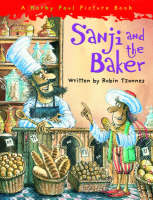
It was the lovely and mystical city of Fratsia that was the class topic and we just followed it in art but creating our own cities (imagination) of Fratsia. We read the book, 'Sanji and The Baker' (by Robin Tzannes and Korky Paul) and studied the city drawings and perspective (new word). We loved how the buildings towered off to the side and rose up the hill. We also loved the colour and medium that Paul had used. We thought about what we would see if we looked straight at a house? What would we see if we were sitting down on a seat in the street looking to the house to our right? (Observational drawing)


We worked with our basic sketching skills to plan our city and think about how the buildings we have created from our imagination would look like from an angle. This was a challenge for most of them. But once they saw what they were looking at and applied it to theirs, it flowed and clicked :-) We then worked with oil pastels and built up this beautiful city like Korky Paul did. Some chalk pastels slipped into the oil pastel box inadvertently so that became a lesson in itself as they were finding out the difference between chalks and oils, in feel, effect, the residue it makes. This was great fun, coming up with adjectives to tell the difference.

I encouraged them to use the oil pastels as we were finishing up with a wash of the colour of their choice (out of red, orange or blue). So they learned they can end with a wash, not just begin with one. I wanted them to see what happens when watery paint touches wax or oil. Those that used chalk in places had a lesson too. they predicted and observed what happened when they ran their final wash over. It did create an awesome sandstormy effect for some! Lovely! I download some of their pics soonish.

In hindsight, I would probably work on laying down more prep work for perspective and focus on observational drawing for a little while...outside of the classroom, drawing the school buildings from different angles. This could be brought in as a follow-up in perspective in year 4.
 

Friday, 26 April 2013

Art Lesson of the Week

Year 6 - charcoal

A new technique for year 6. They thoroughly enjoyed this. This was the first time they had used charcoal. I had the pencils in my room but I brought the willow charcoal along, the stuff that I used as a schoolgirl and loved it. I remember the feeling it gave me, I felt like a proper artist, using a proper tool, so I wanted and hoped they would feel the same too.

We had made clay masks based on our Maori designs we had been working on. As far as the charcoal was concerned we focused on building up the picture by tone - light, mid and dark - rather than drawing an outline and filling it in. This was a challenge for most but they did really well when it clicked what they were looking for.

I will miss this class. They embrace every technique, they try everything, they ask questions, they put their own style on the technique. They want to be there in my lesson and I love seeing them working! 


Saturday, 13 April 2013

Art Lesson of the Week 1

It’s our first week back after the Easter break, a short week, but no less fun! And no better time to start (better late than never) to highlight my fave lessons.

I thought I had already decided on which lesson would be made my favourite before the week was done…but I’ve now learned to not think it’s not over until it’s over. So I’m actually going to highlight two lessons from this week that I saw the kids loved and I also loved too, both for different reasons.

a) Year 4 - Grecian Vases

We looked at the different vases that the Greeks used and talked about the different uses as well as the designs. Some designs highlighted what the purpose of the vase was, some were just decorative and often represented everyday life. We talked about the patterns that were typical of the style. We went to our sketchbooks and planned our own design for our vases. The first year 4 class had the issue of technology fail so I couldn’t show them the pictures in order to compare designs so we went by books, albeit a rather limited number in the class but enough to inspire. This year 4 class tended to focus on pattern and missed the point that many vases depicted scenes from daily life.

I had several templates of three particular vase designs. The children drew around the vase and then filled in the shape with oil pastels. We talked about the difference between oil and chalk pastels and so those who picked up a chalk pastel and worked with it by mistake could tell which it was. They filled in the shape with heavy pastel so that the paint would slip on to it.

I’ve chosen this lesson as a favourite because of the way it evolved during the hour. My original plan was to allow the paint to dry and next week scrape away at it to reveal the colour beneath. But as I demonstrated it it suddenly occurred to me to scrape the paint whilst wet. And it worked brilliantly, as long as the colour underneath was thick and bright, the paint would scrape off it and not lose any of the oil pastel. It was a lot more vibrant. I demonstrated what would happen if it was dry and we all agreed it was a lot better. We ended up as a result finishing the activity in one lesson.

It’s worth making sure that the children lay the crayon/pastel on thick…I showed what would happen if we just shaded gently…the crayon would have been scraped off with the paint and would just leave the paper showing. I just used black ready mixed tempera paint.


This lesson was one that reminded me again why I really like teaching art, it doesn’t have to be prescriptive..as long as the curriculum is followed with the success criteria being met in an evolving lesson then great! I think this is a good lesson for the kids in itself so the children can see how thoughts and plans in art can be developed.

2) Year 6 - Pablo Picasso’s Guernica

This simply was a gobsmacking lesson.

I revelled in the developing thoughts and ideas coming from the 10/11 year olds as we went through the lesson. We started off with a good old PowerPoint on Picasso. I shared my personal opinion of the man; that I think he was a lovely, charming, funny, deepy thoughtful man yet his art does not appeal to me. I went to his exhibition at the Scottish National Gallery of Modern Art in Edinburgh last summer. A great insight in to his life as well as his main works.

The aim today really was to introduce them to the skill of art critiquing, for them to express and justify their thoughts, feelings, likes and dislikes and ultimately aim to offer interpretations (expected to be basic at this stage). I then showed them Guernica – with no background information - and left them with it for 5 minutes to discuss.
Random, chaotic, dull, boring, weird, creepy were the standard and expected responses. A few of the girls were on the right track, suggesting the symbols that may represent war or death.

I then proceeded to tell them the background of Guernica. They had already been studying World War 2 so the vocabulary of battle, Fascists, Communists, And then the floodgates opened! This had obviously sparked the interest of one boy (E) who always had a suggestion or a question at every stage.

I wanted them to share ideas in groups about the painting, creating spidergrams. They were to think about the following questions: why did Picasso paint this in black and white? What was Picasso’s point in painting this? Why abstracted? How does Picasso portray the innocence of the suffering people? (this one was a corker – some great ideas!)

I finished off by showing them Picasso’s weeping woman and we discussed why he could have painted this. This raised some conversation as to why he painted in colour, namely green and blue yet he was painting his interpretation of a sombre event, a mother crying over her son’s dead body. I left them with that query, why colour in this one yet black and white in Guernica. It was interesting trying to get the point across that Picasso was expressing his mood about the battle and the death of innocent people.


I'm really looking forward to the lesson this week and hearing E's research. He has done some full-on homework on it by all accounts!